September 1, 2026
United Nations Headquarters, ECOSOC Chamber, New York
Voices of Korean Atomic Bomb Survivors Brought to International Meeting
on Victim Assistance and Environmental Remediation
On September 1, 2026, the International Meeting on Victim Assistance and Environmental Remediation was held at United Nations Headquarters in New York. The meeting, convened pursuant to UN General Assembly resolution A/RES/79/60, brought together states, civil society, and representatives of communities affected by the use, production, and testing of nuclear weapons to discuss victim assistance and environmental remediation.
Survivors and representatives of affected communities, including from Kazakhstan and Kiribati, shared their experiences and called for stronger international action to address the continuing humanitarian and environmental consequences of nuclear weapons. Among those who spoke were Mary Dickson, a survivor of U.S. nuclear testing in Utah, and Isaiha Mongombe Mombilo, who has raised the impacts of uranium mining and nuclear weapons development. Both are also expected to participate in the International People’s Tribunal on the Atomic Bombings, to be held in Seoul from November 13 to 15, 2026.
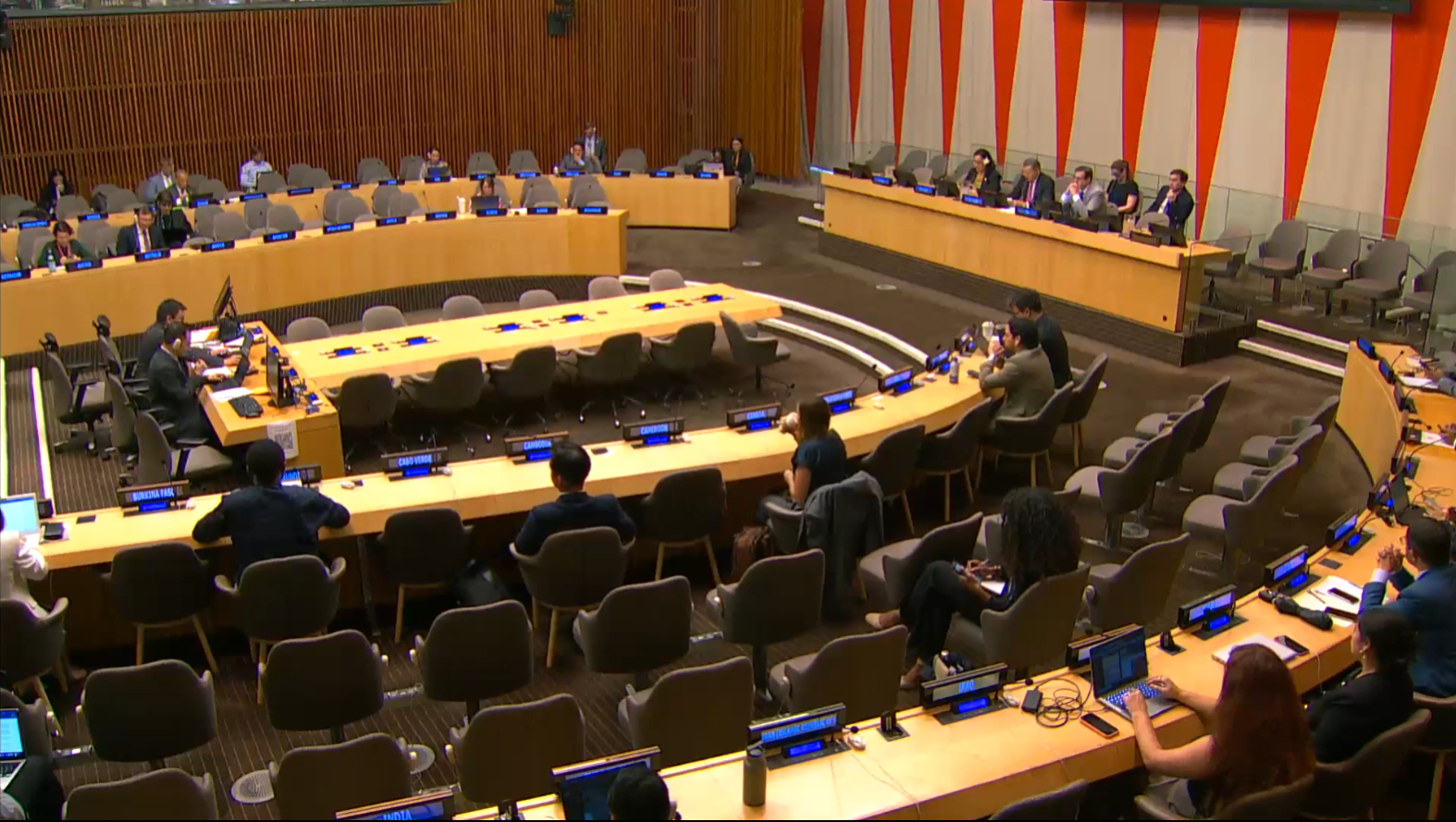
Representatives of participating States at the meeting
Bringing the Voices of Korean Atomic Bomb Survivors to the UN
During the civil society segment, a statement prepared by Solidarity for Peace and Reunification of Korea (SPARK) was presented by Ju-yeon Lee of the Korea Policy Institute (KPI), with support from Hyun-sook Cho of the Korea Peace Now! Grassroots Network (KPN-GN). Both are members of the U.S. Organizing Committee for the International People’s Tribunal on the Atomic Bombings.
The statement emphasized that Korean atomic bomb survivors were exposed to radiation within the historical context of Japan’s occupation and colonial rule of the Korean Peninsula, and that the consequences of the atomic bombings continue 81 years later. It noted that approximately 70,000 Koreans were affected by the bombings and that an estimated 40,000 lost their lives. Today, only approximately 1,580 first-generation survivors remain, while the trauma and effects of the bombings continue to affect subsequent generations.
SPARK stressed that recognition of responsibility is a prerequisite for recognizing survivors’ rights and needs and establishing a just support system. Victim assistance, it emphasized, cannot substitute for responsibility and must be provided alongside official recognition of responsibility.
The statement identified three key demands of Korean atomic bomb survivors:
A comprehensive investigation into the actual conditions of victims and the provision of livelihood support;
Official recognition of second- and third-generation victims, who are currently excluded under South Korea’s Special Act on Support for Atomic Bomb Victims; and
The establishment of memorial facilities and a peace park dedicated to atomic bomb victims.
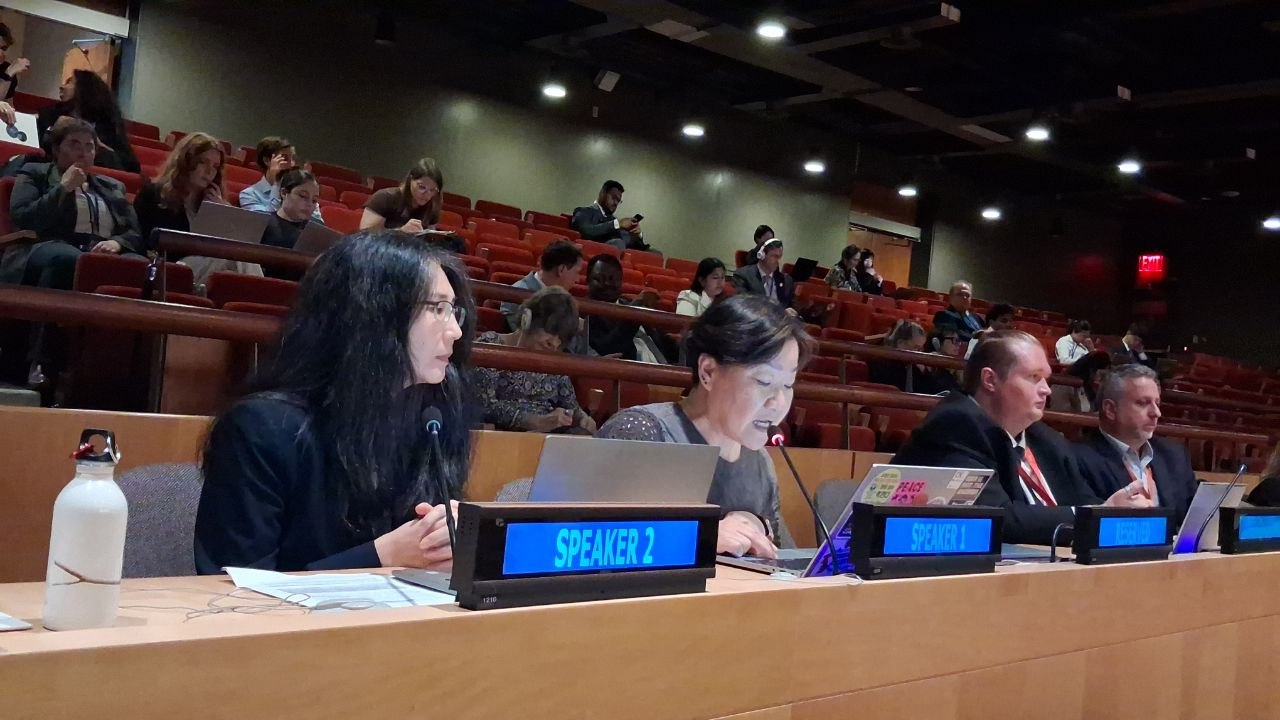
Ju-yeon Lee delivering the statement
The statement also called for the meaningful participation of survivors in international discussions on victim assistance, including discussions under Articles 6 and 7 of the Treaty on the Prohibition of Nuclear Weapons (TPNW). It stressed that Korean survivors should not be excluded from such discussions simply because the Republic of Korea is not a party to the TPNW. Instead, international victim-assistance efforts should be guided by the actual needs and rights of survivors.
Finally, the statement highlighted the upcoming International People’s Tribunal on the Atomic Bombings in Seoul as a concrete effort toward nuclear justice. Korean atomic bomb survivors will testify about their experiences and demand recognition of responsibility, a formal apology, compensation, and guarantees of non-repetition.
Through the UN meeting and the upcoming Tribunal, the voices of Korean atomic bomb survivors are being brought into international discussions on nuclear victim assistance and nuclear justice. The Tribunal seeks to amplify these voices, pursue accountability for the atomic bombings, and contribute to a denuclearized Korean Peninsula and a world free of nuclear weapons.
Read the full statement below and in the attached file.
From Recognition of Accountability to Nuclear Justice: The Voices of Korean Atomic Bomb Survivors
Korean atomic bomb victims were exposed to radiation within the historical context of Japan’s occupation and colonial rule of the Korean Peninsula. When the United States dropped atomic bombs on Hiroshima and Nagasaki in 1945, approximately 70,000 Koreans were affected, and an estimated 40,000 lost their lives. Among all Korean victims, about 20 percent were laborers subjected to forced mobilization under Japanese colonial rule. Upon returning home after liberation, surviving victims endured decades of suffering—afflicted by radiation-related illnesses, government neglect, social stigma, and severe poverty. In 1990, survivor Lee Maeng-hee even attempted suicide by ingesting poison, leaving behind a desperate appeal: “Compensate the atomic bomb victims.”
The suffering caused by the atomic bombings continues to this day, 81 years later, yet the survivors’ calls for their rights and the realization of justice remain ignored. Only approximately 1,580 first-generation survivors remain alive today, most of them around 90 years old and facing the reality that they have little time left. Furthermore, the trauma and aftereffects of the atomic bombings continue to affect the second and third generations.
Korean atomic bomb survivors are living witnesses to the devastating consequences of nuclear weapons, imperialist colonial rule, and the irresponsibility and indifference of their own government. Therefore, recognition of responsibility is a prerequisite for truly recognizing survivors, assessing their needs and rights, and establishing a just support system. However, victim assistance cannot serve as a substitute for responsibility; it must be delivered alongside the official recognition of responsibility. Furthermore, the voices of survivors must be meaningfully reflected in international discussions on victim assistance, including those under Articles 6 and 7 of the Treaty on the Prohibition of Nuclear Weapons (TPNW).
Currently, the primary demand of Korean atomic bomb survivors is the amendment of South Korea’s Special Act on Support for Atomic Bomb Victims. Specifically, they are calling for:
- A comprehensive investigation into the actual conditions of victims and the provision of livelihood support;
- Official recognition of second- and third-generation victims who are currently excluded under the existing Special Act; and
- The establishment of memorial facilities and a peace park dedicated to atomic bomb victims.
However, excluding Korean atomic bomb survivors from international discussions on victim assistance simply because South Korea is not a state party to the TPNW would result in yet another tragic exclusion—following their suffering under colonial rule, the atomic bombings, and decades of government neglect. Therefore, international discussions on victim assistance must be guided by the actual needs and rights of survivors, rather than whether their country is a state party to the TPNW.
Genuine nuclear justice must go beyond recognition of the perpetrators’ accountability and support for survivors; it must also extend to preventing future harm caused by the use or threat of use of nuclear weapons. As a concrete action to realize nuclear justice, an International People’s Tribunal will be held in Seoul this coming November. At this Tribunal, Korean atomic bomb survivors will testify to their past nuclear suffering while demanding recognition of responsibility, a formal apology, compensation, and guarantees of non-repetition.
Through this process, we aim to amplify the voices of Korean atomic bomb survivors within the international community and contribute to achieving a denuclearized Korean Peninsula and a world free of nuclear weapons.


September 1, 2026
United Nations Headquarters, ECOSOC Chamber, New York
Voices of Korean Atomic Bomb Survivors Brought to International Meeting
on Victim Assistance and Environmental Remediation
On September 1, 2026, the International Meeting on Victim Assistance and Environmental Remediation was held at United Nations Headquarters in New York. The meeting, convened pursuant to UN General Assembly resolution A/RES/79/60, brought together states, civil society, and representatives of communities affected by the use, production, and testing of nuclear weapons to discuss victim assistance and environmental remediation.
Survivors and representatives of affected communities, including from Kazakhstan and Kiribati, shared their experiences and called for stronger international action to address the continuing humanitarian and environmental consequences of nuclear weapons. Among those who spoke were Mary Dickson, a survivor of U.S. nuclear testing in Utah, and Isaiha Mongombe Mombilo, who has raised the impacts of uranium mining and nuclear weapons development. Both are also expected to participate in the International People’s Tribunal on the Atomic Bombings, to be held in Seoul from November 13 to 15, 2026.
Representatives of participating States at the meeting
Bringing the Voices of Korean Atomic Bomb Survivors to the UN
During the civil society segment, a statement prepared by Solidarity for Peace and Reunification of Korea (SPARK) was presented by Ju-yeon Lee of the Korea Policy Institute (KPI), with support from Hyun-sook Cho of the Korea Peace Now! Grassroots Network (KPN-GN). Both are members of the U.S. Organizing Committee for the International People’s Tribunal on the Atomic Bombings.
The statement emphasized that Korean atomic bomb survivors were exposed to radiation within the historical context of Japan’s occupation and colonial rule of the Korean Peninsula, and that the consequences of the atomic bombings continue 81 years later. It noted that approximately 70,000 Koreans were affected by the bombings and that an estimated 40,000 lost their lives. Today, only approximately 1,580 first-generation survivors remain, while the trauma and effects of the bombings continue to affect subsequent generations.
SPARK stressed that recognition of responsibility is a prerequisite for recognizing survivors’ rights and needs and establishing a just support system. Victim assistance, it emphasized, cannot substitute for responsibility and must be provided alongside official recognition of responsibility.
The statement identified three key demands of Korean atomic bomb survivors:
A comprehensive investigation into the actual conditions of victims and the provision of livelihood support;
Official recognition of second- and third-generation victims, who are currently excluded under South Korea’s Special Act on Support for Atomic Bomb Victims; and
The establishment of memorial facilities and a peace park dedicated to atomic bomb victims.
Ju-yeon Lee delivering the statement
The statement also called for the meaningful participation of survivors in international discussions on victim assistance, including discussions under Articles 6 and 7 of the Treaty on the Prohibition of Nuclear Weapons (TPNW). It stressed that Korean survivors should not be excluded from such discussions simply because the Republic of Korea is not a party to the TPNW. Instead, international victim-assistance efforts should be guided by the actual needs and rights of survivors.
Finally, the statement highlighted the upcoming International People’s Tribunal on the Atomic Bombings in Seoul as a concrete effort toward nuclear justice. Korean atomic bomb survivors will testify about their experiences and demand recognition of responsibility, a formal apology, compensation, and guarantees of non-repetition.
Through the UN meeting and the upcoming Tribunal, the voices of Korean atomic bomb survivors are being brought into international discussions on nuclear victim assistance and nuclear justice. The Tribunal seeks to amplify these voices, pursue accountability for the atomic bombings, and contribute to a denuclearized Korean Peninsula and a world free of nuclear weapons.
Read the full statement below and in the attached file.
From Recognition of Accountability to Nuclear Justice: The Voices of Korean Atomic Bomb Survivors
Korean atomic bomb victims were exposed to radiation within the historical context of Japan’s occupation and colonial rule of the Korean Peninsula. When the United States dropped atomic bombs on Hiroshima and Nagasaki in 1945, approximately 70,000 Koreans were affected, and an estimated 40,000 lost their lives. Among all Korean victims, about 20 percent were laborers subjected to forced mobilization under Japanese colonial rule. Upon returning home after liberation, surviving victims endured decades of suffering—afflicted by radiation-related illnesses, government neglect, social stigma, and severe poverty. In 1990, survivor Lee Maeng-hee even attempted suicide by ingesting poison, leaving behind a desperate appeal: “Compensate the atomic bomb victims.”
The suffering caused by the atomic bombings continues to this day, 81 years later, yet the survivors’ calls for their rights and the realization of justice remain ignored. Only approximately 1,580 first-generation survivors remain alive today, most of them around 90 years old and facing the reality that they have little time left. Furthermore, the trauma and aftereffects of the atomic bombings continue to affect the second and third generations.
Korean atomic bomb survivors are living witnesses to the devastating consequences of nuclear weapons, imperialist colonial rule, and the irresponsibility and indifference of their own government. Therefore, recognition of responsibility is a prerequisite for truly recognizing survivors, assessing their needs and rights, and establishing a just support system. However, victim assistance cannot serve as a substitute for responsibility; it must be delivered alongside the official recognition of responsibility. Furthermore, the voices of survivors must be meaningfully reflected in international discussions on victim assistance, including those under Articles 6 and 7 of the Treaty on the Prohibition of Nuclear Weapons (TPNW).
Currently, the primary demand of Korean atomic bomb survivors is the amendment of South Korea’s Special Act on Support for Atomic Bomb Victims. Specifically, they are calling for:
However, excluding Korean atomic bomb survivors from international discussions on victim assistance simply because South Korea is not a state party to the TPNW would result in yet another tragic exclusion—following their suffering under colonial rule, the atomic bombings, and decades of government neglect. Therefore, international discussions on victim assistance must be guided by the actual needs and rights of survivors, rather than whether their country is a state party to the TPNW.
Genuine nuclear justice must go beyond recognition of the perpetrators’ accountability and support for survivors; it must also extend to preventing future harm caused by the use or threat of use of nuclear weapons. As a concrete action to realize nuclear justice, an International People’s Tribunal will be held in Seoul this coming November. At this Tribunal, Korean atomic bomb survivors will testify to their past nuclear suffering while demanding recognition of responsibility, a formal apology, compensation, and guarantees of non-repetition.
Through this process, we aim to amplify the voices of Korean atomic bomb survivors within the international community and contribute to achieving a denuclearized Korean Peninsula and a world free of nuclear weapons.